This whole site is something you do, not just read. Here's what each part is for and exactly how to use it — it takes about a minute to read, and then everything will make sense.
1
The Simulator — build a fake story
You go through 5 steps and build a fake news story yourself. At each step you tap one option (a topic, an emotion, a headline, a fake source, a way to spread it). On the right, a preview card shows your "story" forming in real time — the headline appears, the colors shift, the likes climb. At the end you get the full recipe and the point hits you: now you can spot this anywhere. Tap an option, then "Next stage".
2
The 6 Techniques — name the tricks
After you've built a lie, these cards give names to the tricks you just used, so you can recognize them out in the wild. Each card ends with a quick "spot it" question. Just read through them — you can also screenshot any card.
3
You are the Algorithm — the big one
This is the part people find most surprising, so here's exactly how it works. You see a fake feed of 4 posts. Some are calm and normal; some are toxic (loud, angry, manipulative — marked with a red edge). Under each post there's an "Engage" button — that's your tap, like a real like. When you tap a toxic post, you're telling the algorithm "I like this", so it shows you more toxic posts — more of the cards turn red. The bar at the bottom measures how toxic your feed has become, with a live percentage. Tap toxic posts a few times and watch the whole thing turn red and extreme — that's the point: you didn't get shown an echo chamber, you trained one, tap by tap. Tap calm posts and it settles back down.
4
Then vs. Now — same tricks, old history
A side-by-side showing that the same manipulation tricks are a century old — only the delivery changed, from state newspapers to TikTok. Just read across each row.
5
What Now — the 5-second filter
Five simple questions to ask yourself before you share anything. This is the part you actually take with you. There's a button to copy the checklist so you keep it.
Tip: you can switch the whole site between English and Romanian anytime, using the EN / RO buttons at the top right.
An interactive media-literacy experiment
The Fake NewsFactory
Nobody teaches you to spot a lie by showing you the truth. They teach you by showing you how the lie is built. So step inside the factory — and build one yourself.
A project against disinformation · built by Nicholas Carstoiu, 17 · for Freedom House Romania
⚠ Read this firstThis site teaches you to recognise manipulation by letting you assemble it in a safe, fake environment. Nothing here is real. The goal is the opposite of what it looks like: once you have built a lie with your own hands, you can never again be fooled by one. Psychologists call this "prebunking."
SCROLL ↓
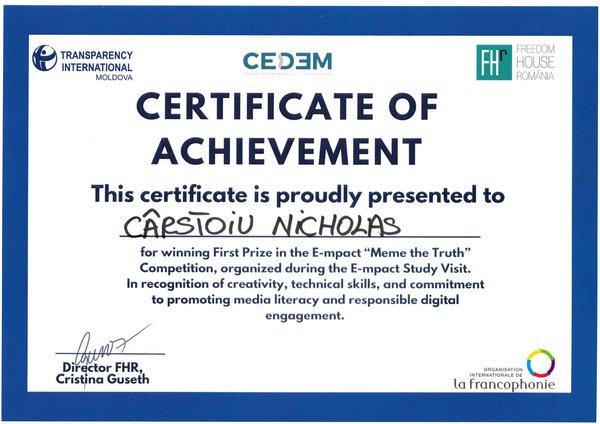
🏅DOUBLE FIRST PRIZE WINNER · 2026🏅
The Fake News Factory won First Prize in two 2026 competitions.
What started as a Social Studies class assignment has become a double-award-winning media-literacy project — recognised nationally and internationally.
1
FIRST PRIZE
JULY 2026 · INTERNATIONAL
Mème la vérité: Démasque la désinfo
Regional competition organised by Freedom House Romania, Center for Democracy and Human Rights (Montenegro) and Transparency International Moldova, with the support of Organisation internationale de la Francophonie. Part of the regional project E-MPACT — Mobilization Against Disinformation.
1
FIRST PRIZE · BETTER WORLD
JULY 2026 · NATIONAL
Grant My Passion 2026 — Better World
National programme organised by McDonald's Romania with the support of The Social Incubator, backing young people whose ideas drive sustainability, social responsibility and real community impact.
01The Simulator
Build a lie in 60 seconds.
Real disinformation isn't random. It's assembled on a production line, step by step, using the same handful of tricks every time. Run the line yourself. Pick each part. Watch a harmless fact mutate into a viral lie — and learn to see the seams.
🔒 factory.local / disinformation-assembly-line
Stage 1 / 5 — Raw material
Pick a boring truth
Every lie starts with something real and dull — a true event nobody would share. Your job in the factory: turn it into a weapon. Choose your raw material.
Stage 2 / 5 — The emotional trigger
Choose the emotion
Facts don't travel. Feelings do. Research shows content that triggers high-arousal emotions — fear, outrage — spreads far faster than calm information. Pick the feeling you want to inject.
Stage 3 / 5 — The headline
Forge the headline
The headline does 90% of the work — most people share without reading further. Strip the nuance. Add absolutes. Make it impossible to scroll past.
Stage 4 / 5 — The fake authority
Add a "source"
A lie needs a costume that looks like credibility. It rarely survives a real source — so we borrow the appearance of one. Pick your disguise.
Stage 5 / 5 — Amplification
Release it
The final stage. You don't need everyone to believe it — just enough angry people to share it, so the algorithm does the rest. Choose your launch tactic.
🏭
You built a typical viral lie.
Here's your production recipe — the exact assembly line behind most disinformation you'll ever see:
Now you can't unsee it.
You just learned the factory's five tricks from the inside: a real seed, an emotional trigger, an absolute headline, a fake source, and engineered amplification. The next time a post hits all five at once — you'll feel the machine working. That feeling is your immunity. That was the whole point.
You've just built it. Now imagine seeing it in your feed.
You just used them. Here they are, named, so you can call them out in the wild. You've probably seen these patterns in posts about vaccines, EU policies, or climate — the topics manipulators target most.
TRICK 01
The Emotion Hijack
If a post makes you instantly furious or scared, that's not an accident — it's the design. Strong emotion switches off the part of your brain that checks facts.
↳ SPOT IT: "Why am I this angry, this fast?"
TRICK 02
The Fake Expert
"Experts say." "A study shows." "Sources confirm." Real sources have names and links. Manipulation hides behind authority you can't verify.
↳ SPOT IT: Can you click through to who actually said it?
TRICK 03
Out Of Context
The most effective lies use real photos and real quotes — just from the wrong time, place, or meaning. The image is true. The story around it isn't.
↳ SPOT IT: Reverse-search the image. Where's it really from?
TRICK 04
Us vs. Them
Disinformation rarely informs — it divides. "They" did this to "us." Once you're on a team, you stop checking and start defending.
↳ SPOT IT: Is this explaining something, or recruiting you?
TRICK 05
Manufactured Urgency
"Share before it's deleted." "Act now." Urgency is a tool to make you skip the one second of thought that would expose the lie.
↳ SPOT IT: Real news doesn't beg you to hurry.
TRICK 06
The Firehose
You don't need one convincing lie — you need a hundred small ones. Flood the zone until checking everything becomes impossible and people give up.
↳ SPOT IT: Volume is not the same as truth.
03The Uncomfortable Truth
You are the algorithm.
Here's the part nobody wants to hear. Disinformation doesn't find you. You train it. The algorithm has no opinions — it watches what you react to, and feeds you more. Try it. Tap "engage" on whatever grabs you.
👇 This is a fake feed. Tap “Engage” on the posts that grab your attention — just like you would in real life. Watch what your feed becomes.
YOUR FEED: calm & balanced15%toxic & extreme
↑ Your feed is almost neutral. Start tapping the posts that interest you.
04Nothing New Under The Sun
History doesn't repeat. Disinfo reuses.
The tricks in the factory aren't a product of the internet. Propaganda has used the exact same machinery for a century — only the delivery changed. Same tool, then and now.
THEN
20th-century regimes invented an external enemy plotting the nation's ruin — to justify control and silence doubt.
The Hidden Enemy
NOW
"They" are secretly engineering a crisis to control us. Same faceless enemy, new hashtag.
THEN
State media repeated a slogan thousands of times until it felt like common sense, regardless of truth.
Repetition as Truth
NOW
A false claim copy-pasted across thousands of accounts until it trends — the "firehose."
THEN
Retouched photographs erased people from history or staged events that never happened.
Faked Evidence
NOW
AI-generated images and deepfakes manufacture "proof" of events that never occurred.
THEN
"You're either with us or against us." No middle ground, no nuance, no questions allowed.
The False Choice
NOW
Every issue flattened into two warring camps online. Doubt gets you branded a traitor to your side.
This section focuses on communication techniques, not historical judgments. The point is not to compare events — it's to recognise that the machinery of manipulation is old, and learning it once protects you across every era.
05Take this with you
What now?
You've seen how a lie is built. Out there, you won't get a warning label — no one will tell you "this is step 3 of manipulation." But the pattern is always there. You don't need to remember everything. You need to notice when something is trying to make you react — and pause.
The 5-second filter — before you share, run this in your head:
1
Who actually said this?
Is there a real, named source — or just "experts say"?
2
What am I feeling right now?
Strong emotion = someone is pushing a button.
3
Is this informing me — or recruiting me?
Facts explain. Manipulation divides.
4
Can I verify this in 10 seconds?
If not, don't amplify it.
5
Why do I want to share this?
To inform — or to react?
If a post hits all five — you're not being informed. You're being engineered.
Next time something shocks you, don't scroll faster. Stop.
That one second of thinking is the only thing the factory can't survive.
You've seen how easy it is to build a lie.
Now ask yourself: how many times have you helped one spread?
You don't fight disinformation by knowing everything. You fight it by not reacting instantly.
FROM CHECKLIST TO TOOL
Try the checklist on a real story.
Paste a headline, post or ad you saw recently — the fact-checker scans it against the 6 techniques and shows you exactly what it finds. Your text stays in your browser. Nothing is sent anywhere.
Hi — I'm Nicholas. I'm 17, I play competitive basketball, and I'm an 11th-grade student at the Romanian-Finnish High School in Bucharest. Over the last few years I've also spent a lot of time in rooms where adults make decisions about young people: as a member of UNICEF Romania's Children's Board since 2023, and of the Children's Advisory Council of the Bucharest City Hall since 2024.
That's also where I kept running into the same problem. My generation lives online — and online is exactly where we get played. Scams, fake AI images, "loverboy" manipulation, ads built to trick us. So I did something about it: I wrote a digital-safety course for teenagers, designed to teach people my age how these traps actually work.
"I don't think you beat disinformation by telling people what's true. You beat it by showing them how the lie was made — so they catch it themselves."
That idea is the whole reason this site exists. Instead of another poster saying "think critically," I wanted to build something you could use — a factory where you assemble a lie with your own hands and walk away immune to it. It's based on a real method psychologists call prebunking, the same logic behind tools built by researchers at the University of Cambridge.
I care about this because I've seen what happens when young people aren't equipped — and because I believe my generation doesn't have to be the most fooled online. We can be the hardest to fool. That's what I'm trying to build, one tool at a time.
SINCE 2023
Member, UNICEF Romania Children's Board
SINCE 2024
Member, Children's Advisory Council of the Bucharest City Hall
2025
Ambassador for Romania, United Citizens of Europe (UCoE)
2026
Founder & CEO of a student startup — JA Gen-E national finalist