SMART ONLINE = SAFE OFFLINE
About the programme
Smart Online = Safe Offline is a free cybersecurity education and awareness programme that I run and teach in schools and high schools. Despite its name, it is not a course about computers - it is a course about people. About behaviour, manipulation, trust, and the decisions we make when no one is next to us to tell us what is right.
Most modern attacks do not start by breaking a computer - they start by manipulating a person. A seemingly trivial message, a link, a photo, a promise, a fake relationship, a game, a contest. Teenagers need to learn that, online, the first firewall is not the computer - it is their own critical thinking. The programme builds healthy reflexes, critical thinking and digital responsibility - without cultivating fear.
How it started
The material at the core of the course was originally created by Alexandru Carstoiu, a risk-management and corporate-governance specialist, to train company employees in information security. Over time it became clear that the most vulnerable group was being left out of these programmes entirely: teenagers. I took the original material, adapted it completely for a young audience, reorganised it from a teaching perspective and enriched it with current examples, case studies and real situations teenagers face every day. Today the course is in permanent development - because the world of cyberattacks never takes a break.
By the numbers
years of free presentations in Bucharest schools
teenagers (14-17) has lived through an online-violence experience (UNICEF 2026)
of cyberattacks start by manipulating a person, not by breaking a computer
cost for the institution, regardless of the number of participants
What we cover
Across roughly 6 hours and 200+ slides, every topic is illustrated with concrete examples, case studies and situations inspired by real events:
Key terms, in plain language
Half of staying safe online is simply knowing what the words mean. These are the core ideas I explain in every session, in the plainest language I can find.
A message that pretends to come from someone you trust - a bank, a game, a friend - to trick you into handing over a password, a code or money. The tell is almost always urgency: do it now, or else.
Hacking the person instead of the device. Rather than break a system, the attacker manipulates emotions - fear, curiosity, the wish to help - so that you open the door yourself.
Any software built to harm you or spy on you, hidden inside an app, a file or a link. When something free feels too generous, malware is often the real price.
Malware that locks your files and demands payment to release them. The safest defence is a boring one: back up your data, so no one can hold it hostage.
A second lock on your account - a code or a tap on your phone - so that a stolen password alone is not enough to get in. It is the single most useful habit I teach.
Everything the internet quietly remembers about you: posts, photos, likes, locations. You cannot erase it, but you can choose what you add to it.
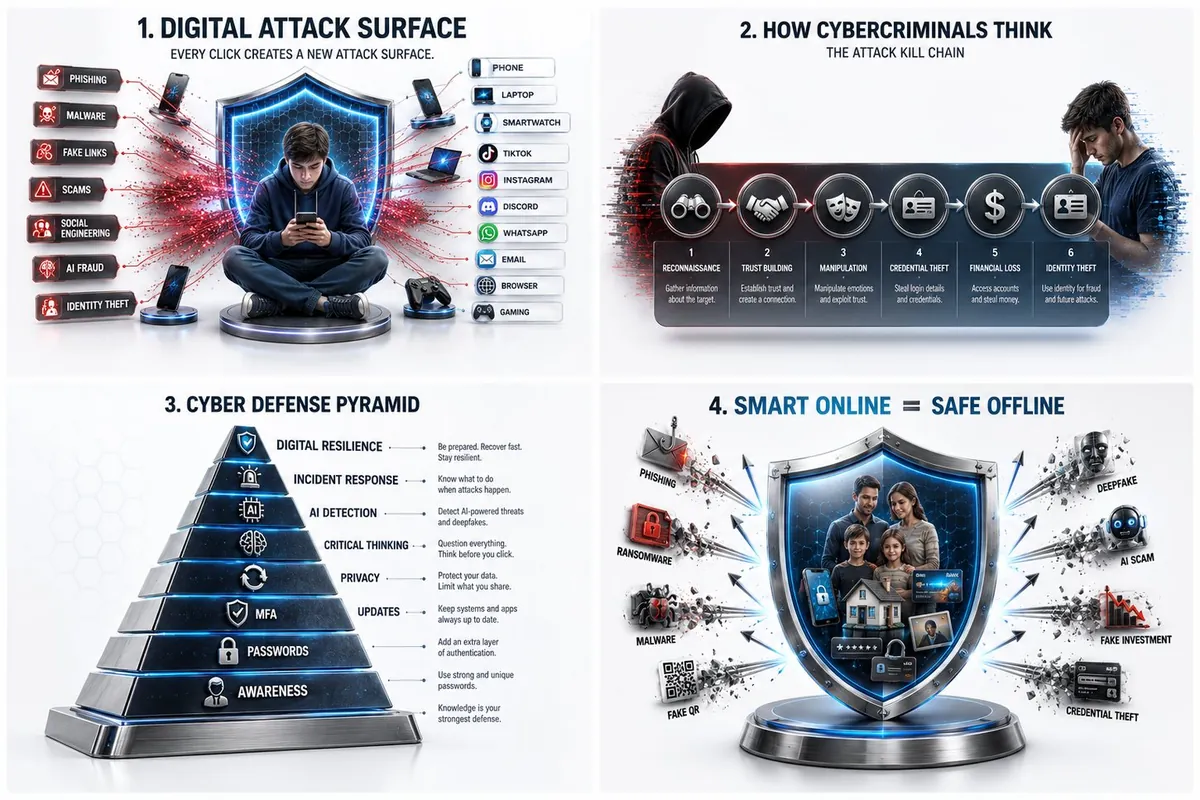
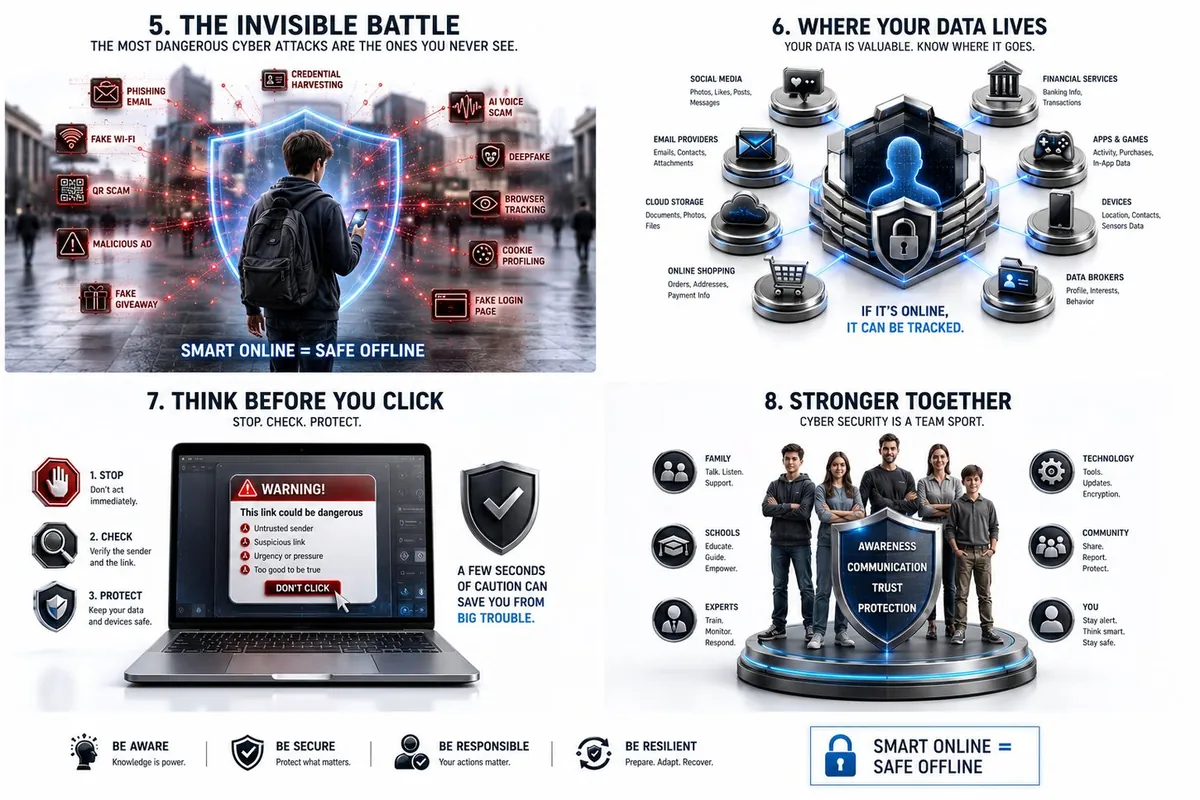
A look inside the course
Who it's for
The core audience - teenagers building their digital autonomy, who spend most of their time on social networks, games and apps.
Often the first to notice a change in behaviour or a warning sign - the course gives them the tools to spot it early and act.
A practical framework to talk with students about online safety, manipulation and mental health.
Protecting a teenager is teamwork between the teenager, the family and the school - together, the strongest prevention team.
Logistics
One session, in a single day: a large room with a projector, two 15-minute breaks and one 30-minute break, no special equipment or cost, adapted to each institution. Free for schools, high schools and colleges across Bucharest and Ilfov.
What I see when I teach it
After three years of doing this in front of real classrooms, the same pattern keeps coming back: teenagers are not careless, they are unprepared. Nobody ever sat down and explained to them how the manipulation actually works.
The questions I hear most are surprisingly practical - How do I know if a link is fake? What happens if I already clicked? Can someone really see my location? - and the moment that changes a room is never a statistic. It is a real, anonymised example of a trick that almost worked on someone their own age. That is when the phones go down and people lean in.
What surprises students most is that the strongest attacks rarely involve code at all. They involve a fake profile, a flattering message, a prize that does not exist, a sense of urgency. Once they see that the target is their attention and their trust, not their device, the whole subject clicks - and prevention stops feeling like a rule and starts feeling like common sense.
The message
“The most powerful antivirus in the world is an informed person.”
Questions and answers
What is Smart Online = Safe Offline?
It is a free cybersecurity education and awareness programme for teenagers, created and taught by Nicholas Carstoiu in schools across Bucharest and Ilfov. It runs to more than 200 slides and covers phishing, online scams, manipulation, privacy and digital responsibility.
How much does it cost?
Nothing. The programme is free for schools, students, teachers and parents.
Who is it for?
It is built for teenagers, and sessions can also be run for teachers and parents, because online safety at that age is a shared responsibility rather than something a young person handles alone.
How can a school request a session?
Schools in Bucharest and Ilfov can request a dedicated session for students, teachers and parents through the contact form on the site. Nicholas replies personally to every request.
Bring it to your school
If you represent a school, high school or other educational institution in Bucharest or Ilfov, you can request a dedicated session for students, teachers and parents. I reply personally to every request and do my best to bring this programme to as many teenagers as possible.
Smart Online = Safe Offline · a programme taught by Nicholas Carstoiu
The course material was originally created by Alexandru Carstoiu for corporate training and was adapted for teenagers by Nicholas Carstoiu; the programme, its adaptation and all the materials on this page are their intellectual property.
They are shared here so the work can be understood and appreciated, and so that schools and educators can request the programme and benefit from it.
They may not be copied, reproduced or used commercially without written permission.